Porto to Cascais Private Transfer with Sightseeing Stops
Travel directly from:
Porto
to:
Cascais
in one private vehicle.
The direct road journey is approximately:
330–340 km
and normally requires around:
3 hours 20 minutes to 3 hours 40 minutes of direct driving
depending on:
- Traffic
- Exact collection location in Porto
- Porto metropolitan traffic
- Motorway conditions
- Roadworks
- Lisbon-region traffic
- Exact Cascais destination
- Comfort breaks
For realistic door-to-door planning, allow approximately:
3.5–4 hours
and additional margin during particularly busy travel periods.
Direct Transfer or Sightseeing Transfer?
You decide how you want to travel.
Direct Transfer
Travel:
Porto → Cascais
using the most efficient available road route.
Choose the direct option when your priority is:
- Reaching Cascais efficiently
- Hotel-to-hotel transportation
- Travelling with children
- Travelling with substantial luggage
- Avoiding railway stations
- Avoiding coach terminals
- Avoiding train changes
- Maintaining privacy
- Reaching Cascais earlier in the day
Sightseeing Transfer
Transform the journey south into part of your Portugal holiday.
Choose from:
Aveiro
Coimbra
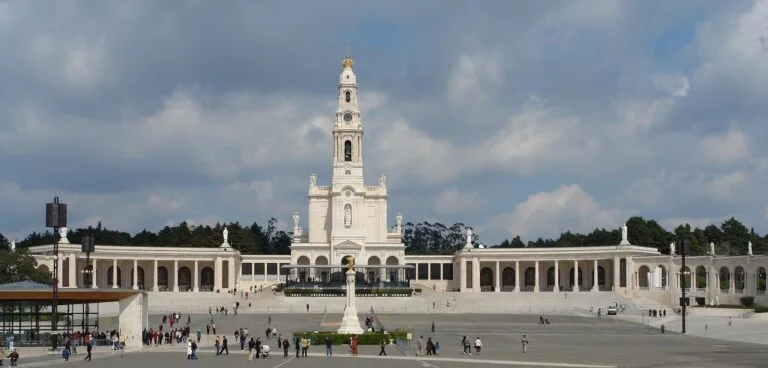
Fátima
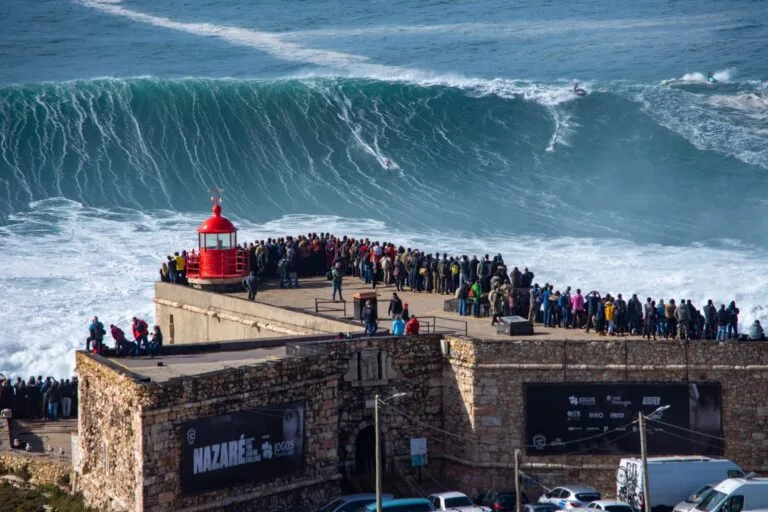
Nazaré
Óbidos
before reaching:
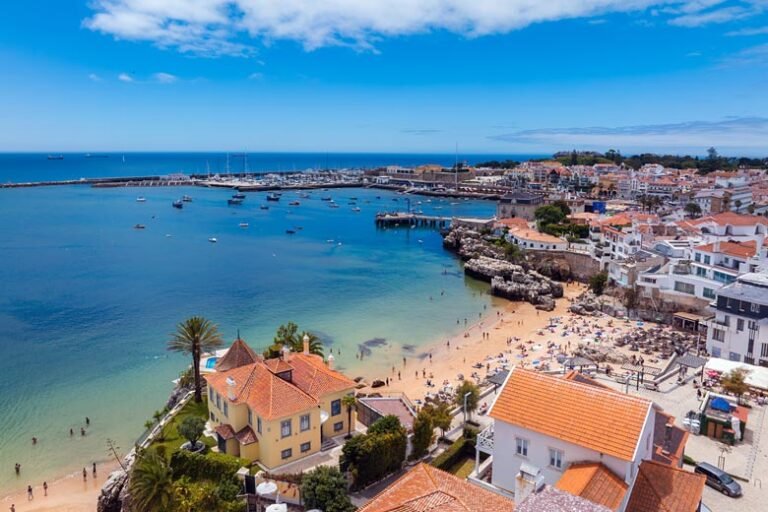
Cascais
Every Sightseeing Stop Is Optional
The itinerary can be completely adapted to your interests.
For example:
Porto → Aveiro → Cascais
or:
Porto → Coimbra → Cascais
or:
Porto → Aveiro → Coimbra → Cascais
or:
Porto → Coimbra → Nazaré → Cascais
or:
Porto → Coimbra → Nazaré → Óbidos → Cascais
or:
Porto → Aveiro → Coimbra → Fátima → Cascais
or the complete sightseeing route:
Porto → Aveiro → Coimbra → Fátima → Nazaré → Óbidos → Cascais
Do We Recommend Visiting All Five Stops?
It is possible.
However, the complete itinerary should be treated as a:
full-day private sightseeing transfer
rather than a simple Porto to Cascais journey.
With:
- Five sightseeing stops
- Walking
- Lunch
- Comfort breaks
- Parking
- Historic-centre access
the complete journey can realistically become:
10–12+ hours
depending on:
- Traffic
- Attraction opening hours
- Walking speed
- Restaurant duration
- Individual stop duration
- Seasonal congestion
For most travellers, we recommend:
2–3 principal stops
rather than trying to explore all five destinations extensively.
Our Main Recommendation — Coimbra
If you choose only one substantial cultural stop:
choose Coimbra.
Coimbra gives the journey real depth while remaining naturally positioned between Porto and Cascais.
The city combines:
- One of Europe’s oldest universities
- UNESCO heritage
- Medieval streets
- Portuguese academic traditions
- Mondego River
- Historic churches
- Romanesque architecture
- Traditional city centre
Coimbra is also our preferred:
lunch stop
for most sightseeing itineraries.
Suggested Stop Durations
A practical guideline is:
Aveiro — 45–90 minutes
Coimbra — 1.5–2.5 hours
Fátima — 45–60 minutes
Nazaré — 45–60 minutes
Óbidos — 45–60 minutes
Longer visits can be arranged when your schedule allows.
Which Stops Do We Recommend?
If You Want Only One
Coimbra
If You Want Two
Coimbra + Óbidos
This is our strongest two-stop cultural combination.
If You Want Three
Coimbra + Nazaré + Óbidos
This gives you:
historic university city + Atlantic coast + medieval Portugal
Best Religious & Cultural Combination
Coimbra + Fátima
Best Scenic Combination
Aveiro + Nazaré
Best History Combination
Coimbra + Óbidos
Best Balanced Three-Stop Route
Coimbra + Nazaré + Óbidos
Complete Route
Aveiro + Coimbra + Fátima + Nazaré + Óbidos
Collection in Porto
Private collection can be arranged throughout Porto and accessible surrounding areas.
This can include:
- Porto historic centre
- Ribeira
- Baixa
- Aliados
- Bolhão
- Cedofeita
- Boavista
- Foz do Douro
- Campanhã
- Porto São Bento area
- Hotels
- Apartments
- Private residences
Collection from:
- Vila Nova de Gaia
- Porto Airport
- Other surrounding areas
can also be arranged when booked accordingly.
Porto Historic Centre
Parts of Porto’s historic centre contain:
- Narrow streets
- Steep streets
- Pedestrian zones
- Controlled traffic
- Limited stopping areas
Your driver will collect you as close as legally and safely possible to your accommodation.
Ribeira
Collection can be arranged around accessible areas near:
Ribeira
although the historic riverfront includes:
- Narrow streets
- Pedestrian sections
- Restricted vehicle access
- Busy tourist areas
The driver will use an appropriate meeting point where necessary.
Avenida dos Aliados
Private collection can begin around:
Avenida dos Aliados
or nearby accessible streets when this is your departure area.
São Bento
Collection near:
São Bento Railway Station
can be arranged from an appropriate road-accessible meeting point.
Porto Campanhã
Private collection can begin directly from:
Campanhã
Porto’s principal long-distance railway hub.
Boavista
Collection is available throughout:
Boavista
including:
- Hotels
- Apartments
- Business accommodation
- Casa da Música area
Foz do Douro
Your transfer can also begin from:
Foz do Douro
when entered as the actual origin.
Because Foz lies west of central Porto, the exact pickup point may slightly affect:
- Distance
- Journey time
- Route
- Price
Vila Nova de Gaia
Collection from:
Vila Nova de Gaia
can also be arranged when booked accordingly.
This can include:
- Riverside accommodation
- Hotels
- Apartments
- Port wine lodge area
- Private residences
The route may differ slightly from a central Porto departure.
Porto Airport
Private collection can begin directly from:
Francisco Sá Carneiro Airport — OPO
when booked accordingly.
Airport collection is different from a standard city pickup because flight arrival and airport waiting conditions apply.
Why Start with Aveiro?
Aveiro works well as the first stop because it is:
- Relatively close to Porto
- Compact
- Easy to explore
- Visually distinctive
- Relaxed compared with larger historic cities
It allows you to begin sightseeing without immediately committing to a long walking visit.
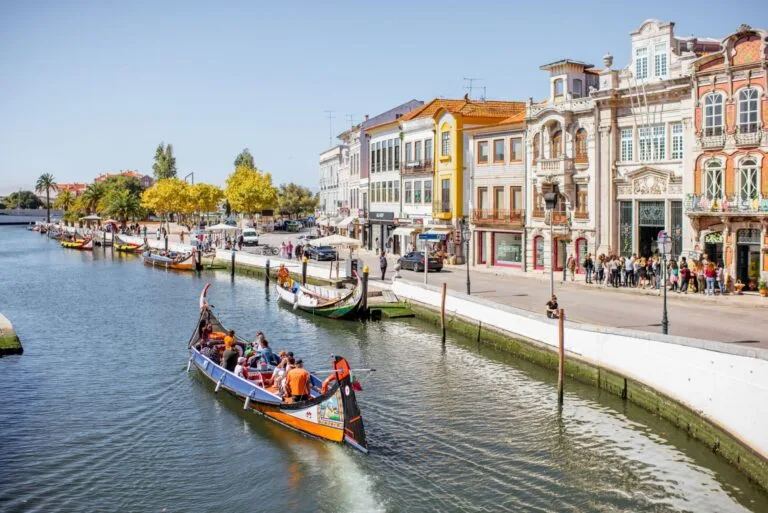
Aveiro Canals
The centre is crossed by canals connected with the:
Ria de Aveiro
and these waterways form one of the city’s defining characteristics.
Moliceiro Boats
The colourful:
moliceiros
were historically used for collecting algae and seaweed in the lagoon.
Today, many are used for:
visitor boat trips.
Can We Take a Moliceiro Tour During the Transfer?
Potentially.
However, a boat trip normally requires considerably more time than a simple sightseeing stop.
If you want a moliceiro cruise:
request additional time in advance.
Art Nouveau
Aveiro has a notable collection of:
Art Nouveau architecture
particularly around the central canal.
Rossio
The central Rossio area is a convenient location for:
- Walking
- Canal views
- Restaurants
- Cafés
- Boat departures
- Art Nouveau buildings
Ovos Moles
Aveiro is particularly famous for:
ovos moles
a traditional sweet made principally from:
often presented in decorative wafer shapes.
Aveiro Railway Station
The historic railway-station building is known for decorative:
azulejo panels
depicting regional scenes.
Can Aveiro Be Only 45 Minutes?
Yes.
A short stop can focus on:
- Central canal
- Moliceiro boats
- Art Nouveau façades
- Ovos moles
For a more relaxed visit:
60–90 minutes
works better.
Is Aveiro Good for Breakfast or Coffee?
Yes.
Because Aveiro is the first major sightseeing stop after Porto, it works particularly well for:
- Coffee
- Pastries
- Ovos moles
- A short morning break
Can Aveiro Be Our Lunch Stop?
Yes.
However, for most complete sightseeing itineraries:
Coimbra remains our principal recommended meal stop.
Why Is Coimbra Our Main Recommendation?
Coimbra is large enough to provide a substantial cultural experience but still works naturally within the Porto → Cascais route.
It gives the journey a strong progression:
Porto & the Douro
↓
Aveiro canals
↓
historic Coimbra
↓
Fátima
↓
Atlantic Nazaré
↓
medieval Óbidos
↓
Cascais & the Atlantic coast
University of Coimbra
The University of Coimbra is:
the oldest university in Portugal
and one of Europe’s oldest universities.
Its historic university complex forms part of the:
UNESCO World Heritage
classification encompassing:
- University
- Alta
- Rua da Sofia
Paço das Escolas
The historic university courtyard is one of Coimbra’s most important monumental spaces.
Joanina Library
The:
Biblioteca Joanina
is one of the university’s most famous interiors.
Entry can involve:
- Ticket
- Timed access
- Visitor restrictions
Advance planning may be useful during busy periods.
University Tower
Depending on access conditions, visitors can climb the university tower for panoramic views.
Sé Velha
Coimbra’s Old Cathedral is one of Portugal’s most important Romanesque buildings.
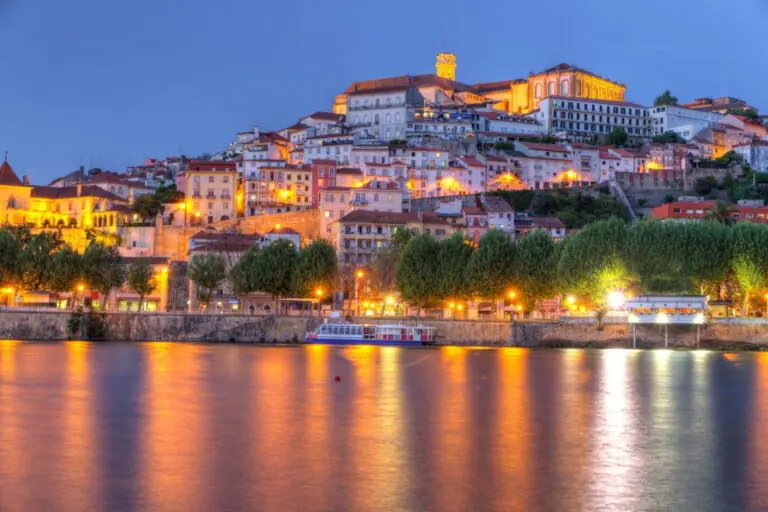
Historic Upper Town
Coimbra’s historic centre rises steeply from the river towards the University.
Travellers should expect:
- Slopes
- Cobbles
- Steps
- Narrow streets
Mondego River
The:
Mondego
runs through Coimbra and forms an important part of the city’s landscape.
Lunch in Coimbra
Coimbra is our:
principal recommended lunch stop
on the complete Porto to Cascais itinerary.
A balanced visit can include:
1.5–2.5 hours
for:
- University area
- Historic centre
- Lunch
- Short walk
- Coffee
For a deeper university visit:
allow longer.
Can Coimbra Be Only One Hour?
Yes.
A short orientation can focus on:
- University surroundings
- Historic centre
- Viewpoints
However, for most travellers:
1.5–2.5 hours
is much more worthwhile.
Coimbra Academic Traditions
Coimbra has a strong student identity developed over centuries.
The city is particularly associated with:
- Academic dress
- University traditions
- Student ceremonies
- Coimbra Fado
Coimbra Fado
Coimbra has its own distinctive musical tradition:
Fado de Coimbra
historically associated with:
- University students
- Serenades
- Academic culture
Is Fátima Only for Religious Travellers?
No.
Religious significance is the principal reason to visit, but travellers may also be interested in:
- Modern Portuguese history
- Architecture
- Pilgrimage culture
- Social history
Chapel of the Apparitions
The:
Chapel of the Apparitions
occupies the symbolic heart of the Sanctuary.
Basilica of Our Lady of the Rosary
The Basilica contains the tombs of:
- Francisco
- Jacinta
- Sister Lúcia
Basilica of the Holy Trinity
The modern:
Basilica of the Holy Trinity
stands opposite the older basilica across the main prayer area.
Can Fátima Be Only 45 Minutes?
Yes.
A short visit can focus on:
- Main Sanctuary
- Chapel of the Apparitions
- Exterior of the basilicas
Is There a Dress Code?
Visitors should use respectful clothing appropriate to a religious sanctuary.
Does Fátima Become Very Busy?
Yes.
Visitor numbers can increase substantially during:
- Major pilgrimages
- Religious celebrations
- 13 May
- 13 October
- Anniversary periods
Additional time may be required.
Can We Attend Mass?
Potentially.
Mass schedules are managed by the Sanctuary and can vary.
If attending Mass is important to your journey, allow additional time and check the relevant schedule before travelling.
Why Visit Nazaré?
Nazaré introduces the Atlantic Ocean directly into the sightseeing journey.
After Aveiro, Coimbra and Fátima, the route changes atmosphere completely.
You move from:
historic and religious Portugal
to:
open Atlantic coastline.
Praia da Nazaré
The main beach forms a broad crescent directly beside the town.
It remains one of Nazaré’s defining landscapes.
Fishing Heritage
Nazaré has a long history connected with:
- Fishing
- Traditional boats
- Fish drying
- Seafood
- Local dress
The town retains one of Portugal’s most recognisable coastal identities.
Sítio da Nazaré
Above the main beach lies:
Sítio
the elevated historic area overlooking the coast.
It provides some of the best panoramic views over:
- Nazaré
- Main beach
- Atlantic Ocean
- Coastline
Praia do Norte
North of Sítio lies:
Praia do Norte
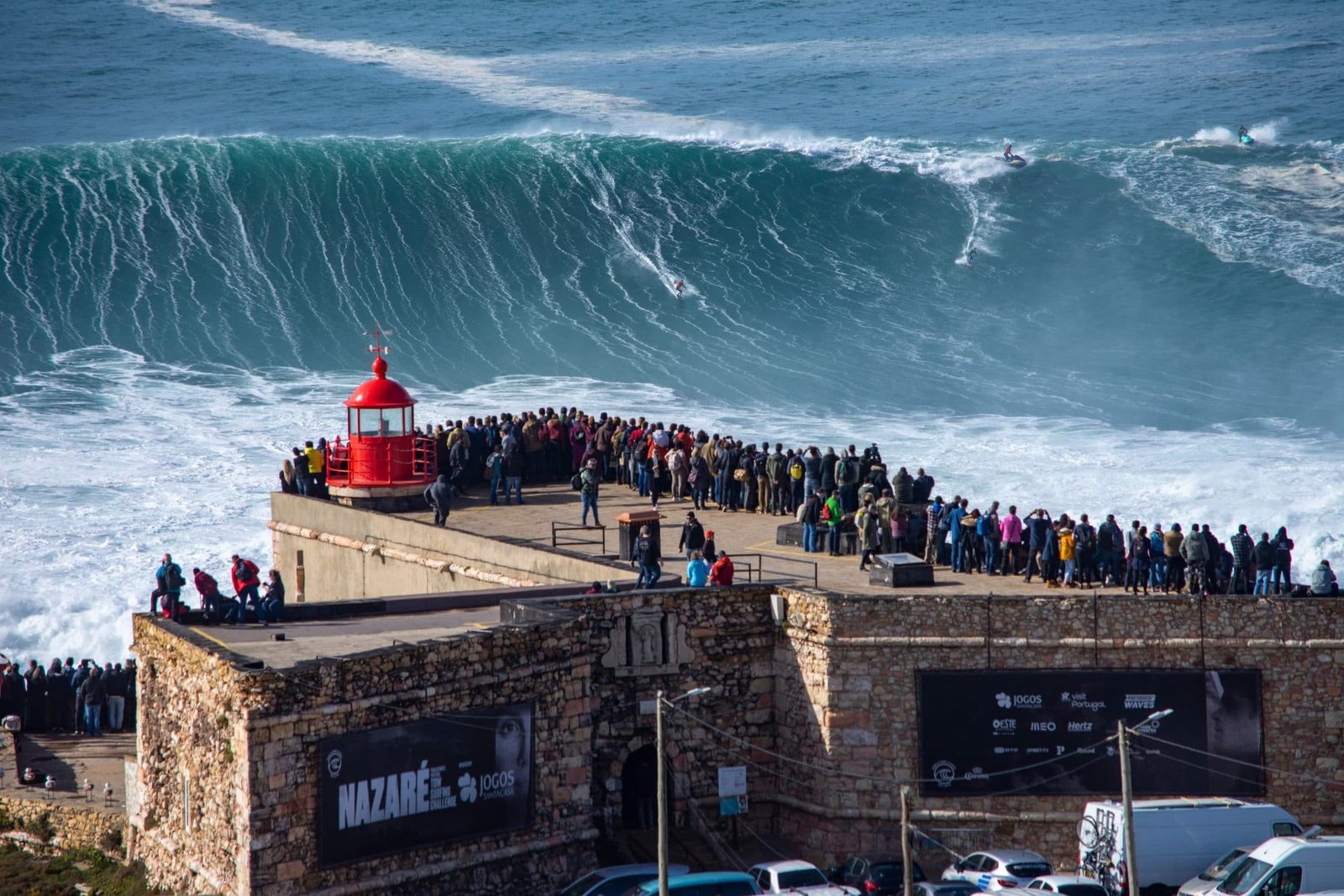
internationally known for very large Atlantic waves under specific ocean conditions.
Wave size varies enormously according to:
Large waves are never guaranteed.
Can We See Giant Waves?
Possibly during suitable winter swells.
However:
giant waves cannot be guaranteed.
Are Giant Waves Visible All Year?
No.
The famous extreme-wave conditions occur only when the necessary Atlantic swell and weather conditions combine.
Can Nazaré Be Only 45 Minutes?
Yes.
A short scenic stop can focus on:
- Sítio viewpoint
- Main beach
- Photography
Lunch in Nazaré
Nazaré can also be used as a lunch stop.
It is particularly suitable for travellers interested in:
- Fresh fish
- Seafood
- Atlantic views
However, for the complete route:
Coimbra remains our main recommended lunch stop.
Why Finish with Óbidos?
Óbidos works extremely well as the final sightseeing stop because it is:
- Compact
- Visually impressive
- Easy to combine with the journey towards Cascais
- Historically distinctive
It provides a final cultural experience without requiring several hours before the last section of the drive.
Óbidos Historic Centre
Inside the walls you will find:
- Whitewashed houses
- Narrow cobbled streets
- Bougainvillea
- Churches
- Traditional shops
- Historic architecture
Óbidos Castle
The castle dominates the fortified town and forms part of one of Portugal’s most recognisable medieval landscapes.
Town Walls
Óbidos retains its historic defensive walls.
Walking sections of the walls can provide excellent views, but travellers should be aware that:
- Surfaces may be uneven
- Protective railings can be limited
- Access can involve steps
This is not suitable for every traveller.
Porta da Vila
The principal gateway into the historic centre is:
Porta da Vila
one of the most recognisable entrances to Óbidos.
Igreja de Santa Maria
Inside the old town, the Church of Santa Maria occupies an important central position.
Ginjinha de Óbidos
Óbidos is famous for:
Ginjinha de Óbidos
a traditional cherry liqueur.
It is often served:
in a small chocolate cup.
Alcohol consumption is entirely optional.
Can Óbidos Be Only 45 Minutes?
Yes.
A short stop can focus on:
- Porta da Vila
- Main street
- Castle surroundings
- Photography
For a more relaxed visit:
60–90 minutes
is preferable.
Vehicle Access in Óbidos
The historic walled centre is not designed for normal vehicle circulation.
Your driver will use an appropriate parking or passenger-access area outside the historic core.
Sightseeing inside the walls is largely:
on foot.
Best Sightseeing Combinations
Best Single Stop
Coimbra
Best Two Stops
Coimbra + Óbidos
Best Three Stops
Coimbra + Nazaré + Óbidos
Religious & Cultural
Coimbra + Fátima
Coast & Culture
Coimbra + Nazaré
Historic Portugal
Coimbra + Óbidos
Scenic & Relaxed
Aveiro + Nazaré
Complete Journey
Aveiro + Coimbra + Fátima + Nazaré + Óbidos
Can We Visit All Five Stops?
Yes.
However, the journey becomes a full sightseeing day.
A possible itinerary is:
Early Porto departure
↓
Aveiro — 45–60 min
↓
Coimbra — 1.5–2h including lunch
↓
Fátima — 45 min
↓
Nazaré — 45–60 min
↓
Óbidos — 45–60 min
↓
Cascais — evening arrival
Exact timing depends on:
- Traffic
- Parking
- Attraction opening hours
- Walking
- Restaurant duration
- Seasonal congestion
- Comfort breaks
What If We Want a Shorter Day?
For most travellers, we strongly recommend choosing:
two or three stops
rather than all five.
For example:
Cultural
Coimbra + Óbidos
Scenic
Coimbra + Nazaré
Balanced
Coimbra + Nazaré + Óbidos
Religious
Coimbra + Fátima
Relaxed
Aveiro + Coimbra
Porto to Cascais by Private Driver
Booking a private driver from Porto to Cascais provides:
- Porto hotel collection
- Ribeira collection where access permits
- Boavista collection
- Foz collection when booked accordingly
- Gaia collection when booked accordingly
- One private vehicle
- Direct Cascais hotel delivery
- Flexible departure
- Luggage transportation
- Optional sightseeing
- Child seats
- Comfort breaks
Porto to Cascais by Car with Driver
Private transportation allows you to travel south without:
- Driving yourself for several hours
- Renting a vehicle
- Returning a rental car
- Navigating motorway traffic
- Parking during sightseeing
- Carrying luggage through stations
- Changing trains
- Transferring through Lisbon
- Repeated luggage handling
Private Transfer vs Train
Rail travel between Porto and Cascais normally requires more than one transport stage.
A typical journey can involve:
- Porto accommodation → Campanhã
- Long-distance train to Lisbon
- Local transportation or railway connection
- Lisbon → Cascais
- Cascais station → final accommodation
Efficient public-transport itineraries can be competitive in total journey time.
However, there is no one-seat railway journey directly from:
your Porto accommodation
to:
your Cascais accommodation.
Private transportation instead provides:
Porto accommodation → Cascais accommodation
in one vehicle.
Is the Train Faster?
The train can be:
competitive
for travellers staying near railway stations and travelling without substantial luggage.
A private transfer is not necessarily the fastest option for every traveller.
Its principal advantages are:
- Door-to-door service
- Privacy
- No station changes
- Flexible departure
- Luggage convenience
- Child seats
- Sightseeing opportunities
Private Transfer vs Bus
Bus services connect Porto with the Lisbon region, but reaching Cascais normally requires additional transportation.
A public-transport journey can involve:
- Porto departure terminal
- Long-distance coach
- Lisbon arrival
- Local connection towards Cascais
- Final transportation to accommodation
A private transfer avoids:
- Bus terminals
- Fixed departure times
- Shared passenger environment
- Final local transportation
- Repeated luggage handling
Private Transfer vs Flying
Flying from Porto to Lisbon is possible.
However, a complete air journey to Cascais requires:
- Porto accommodation → Porto Airport
- Check-in
- Security
- Boarding
- Flight
- Lisbon Airport arrival
- Baggage collection
- Lisbon Airport → Cascais
A well-timed flight can be competitive.
However, direct road transportation avoids:
- Airport procedures
- Airport transfers
- Airline baggage restrictions
- Fixed airline schedules
Is a Private Transfer Always Faster Than Flying?
No.
A suitable flight can sometimes produce a competitive total journey time.
Private transportation instead prioritises:
- Convenience
- Privacy
- Door-to-door travel
- Flexible timing
- Sightseeing
- Luggage convenience
Travelling with Children
Child seats are available:
free of charge on request
Please provide children’s approximate ages.
Depending on requirements, this can include:
- Baby seats
- Child seats
- Booster seats
Travelling with Luggage
Standard luggage allowance is approximately:
1 medium suitcase + 1 cabin bag per passenger
subject to vehicle capacity.
Please inform us before booking if travelling with:
- Several large suitcases
- Golf bags
- Bicycles
- Surfboards
- Pushchairs
- Wheelchairs
- Other oversized equipment
Golf Equipment
Golf equipment can be transported subject to vehicle capacity.
Please declare:
- Number of passengers
- Golf bags
- Suitcases
before booking.
Bicycles
Bicycles may be transported subject to prior confirmation and suitable vehicle capacity.
Surfboards
Surfboards can potentially be transported depending on:
- Board dimensions
- Passenger number
- Other luggage
- Vehicle type
Prior confirmation is required.
Travelling with Reduced Mobility
Please provide exact requirements before booking.
Sightseeing destinations can contain:
- Cobblestones
- Slopes
- Steps
- Historic paving
- Pedestrian areas
- Restricted vehicle access
Coimbra and Óbidos in particular can involve:
- Steep sections
- Uneven historic surfaces
Aveiro is generally flatter and may offer an easier walking environment for some travellers.
Comfort Breaks
Reasonable comfort breaks can be arranged throughout the journey.
Waiting Time
For standard non-airport collection:
20 minutes
of waiting are included.
Additional waiting may be charged at:
€10 per additional 15 minutes
subject to driver availability.
Airport pickup waiting conditions may differ according to the booking.
What Time Should We Leave Porto?
Direct Transfer
Departure can be arranged throughout the day subject to availability.
One Sightseeing Stop
Morning departure works well.
Two or Three Stops
Earlier morning departure is recommended.
All Five Stops
An:
early morning departure
is strongly recommended.
Can We Leave Porto After Lunch?
Yes for the direct transfer.
For substantial sightseeing:
we do not recommend a late departure.
Can We Travel at Night?
Yes, subject to availability.
Sightseeing becomes limited by:
- Daylight
- Attraction opening hours
- Restaurant schedules
Are Sightseeing Tickets Included?
No, unless specifically stated.
Potential admission charges can include:
- University of Coimbra
- Joanina Library
- Museums
- Religious monuments
- Other attractions
Can We Buy Tickets in Advance?
Yes.
For attractions such as:
University of Coimbra
advance tickets can be useful during busy periods.
Avoid booking excessively tight timed entries because road traffic and earlier sightseeing can affect arrival.
Can We Change Stops During the Journey?
Potentially.
Changes depend on:
- Driver hours
- Route
- Traffic
- Parking
- Additional distance
- Operational feasibility
Can We Add Another Stop?
Potentially.
Request additional destinations before departure whenever possible.
They can affect:
- Distance
- Driving time
- Driver hours
- Arrival time
- Price
Arriving in Cascais
Private drop-off can be arranged throughout Cascais and accessible surrounding areas.
This can include:
- Cascais historic centre
- Cascais Marina
- Cascais Railway Station
- Monte Estoril
- Estoril
- Quinta da Marinha
- Guincho
- Hotels
- Apartments
- Villas
- Private residences
when booked accordingly.
Cascais Historic Centre
Some streets in central Cascais contain:
- Pedestrian sections
- Narrow access
- Traffic restrictions
- Limited stopping areas
Your driver will take you as close as legally and safely possible to your accommodation.
Cascais Marina
Private drop-off can be arranged around accessible locations near:
Cascais Marina
when this is your destination.
The marina area is well positioned for access to:
- Historic centre
- Waterfront
- Restaurants
- Hotels
- Coastal walks
Cascais Railway Station
Private drop-off can be arranged at an appropriate passenger-access point around:
Cascais Railway Station
when required.
Estoril
Your journey can finish in:
Estoril
when entered as the actual destination.
Estoril forms part of the wider Cascais coastline and is particularly associated with:
- Seafront
- Beaches
- Hotels
- Casino Estoril
- Promenade
- Restaurants
Monte Estoril
Private drop-off can be arranged at accessible:
- Hotels
- Apartments
- Private residences
around:
Monte Estoril
when booked accordingly.
Quinta da Marinha
Private transportation can continue to:
Quinta da Marinha
including:
- Hotels
- Resorts
- Golf accommodation
- Villas
- Private residences
when entered as the destination.
Guincho
Private drop-off can also be arranged around:
Guincho
when booked accordingly.
Because Guincho lies west of central Cascais, the exact destination may affect:
- Distance
- Journey time
- Route
- Price
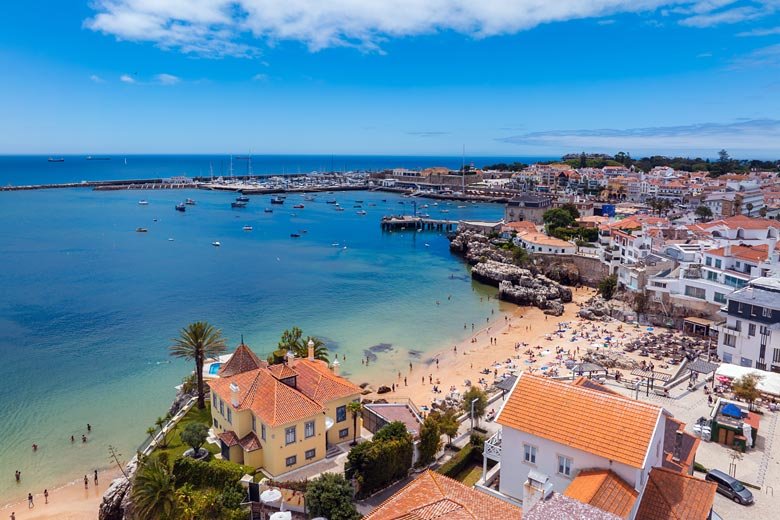
Discover Cascais
Cascais is one of Portugal’s best-known coastal destinations.
The town developed from a traditional fishing community into a major seaside destination and is particularly associated with:
- Atlantic coastline
- Historic centre
- Beaches
- Marina
- Seafront promenades
- Restaurants
- Villas
- Surfing
- Golf
- Easy access to Sintra
Cascais Historic Centre
The historic centre combines:
- Traditional Portuguese streets
- Small squares
- Restaurants
- Cafés
- Shops
- Beaches
- Seafront atmosphere
Much of the central area can be explored on foot.
Cascais Beaches
Central Cascais includes several small urban beaches within walking distance of the historic centre.
These help give the town its distinctive combination of:
historic centre + Atlantic resort.
Praia da Rainha
One of the best-known small beaches in central Cascais is:
Praia da Rainha
located close to the pedestrian centre.
Praia da Conceição
Another central beach area lies near:
Praia da Conceição
with easy access to the seafront promenade.
Cascais Marina
The marina lies east of the historic centre and provides:
- Waterfront restaurants
- Boat activity
- Coastal views
- Access towards the western coastline
Boca do Inferno
West of central Cascais lies:
Boca do Inferno
a dramatic rocky coastal formation shaped by Atlantic erosion.
It can be visited after arrival depending on:
- Time
- Weather
- Light
- Your accommodation location
Guincho
Further west lies:
Praia do Guincho
one of the most recognisable beaches on the Cascais coastline.
It is particularly associated with:
- Atlantic scenery
- Wind
- Surfing
- Kitesurfing
- Large sandy landscapes
Cascais & Sintra
Cascais is also a convenient base for visiting:
Sintra
and the surrounding natural and historical landscape.
A separate excursion can include:
- Sintra historic centre
- Pena Palace
- Quinta da Regaleira
- Cabo da Roca
- Coastal roads
- Guincho
Cabo da Roca
Cabo da Roca lies northwest of Cascais and can be visited separately as part of a Sintra and coastal itinerary.
It is known as the westernmost point of mainland continental Europe.
Cascais & Lisbon
Cascais also offers straightforward access to:
Lisbon
making it possible to combine a quieter Atlantic base with visits to the Portuguese capital.
Cascais Food
The Cascais coastline is particularly associated with:
- Fresh fish
- Seafood
- Atlantic cuisine
- Portuguese traditional dishes
Nearby coastal areas provide numerous restaurant options.
Cascais & Golf
The wider Cascais area includes several golf courses and golf resorts.
Golf travellers should provide:
- Number of passengers
- Golf bags
- Other luggage
before booking so that a suitable vehicle can be assigned.
Cascais & the Atlantic
The Atlantic Ocean defines much of Cascais’s identity.
The coastline changes rapidly from:
- Sheltered central beaches
to:
and then towards:
- Guincho’s open Atlantic beach.
Cascais as a Base
Cascais can be used as a base for onward travel towards:
- Lisbon
- Sintra
- Estoril
- Cabo da Roca
- Ericeira
- Setúbal region
- Alentejo
- Algarve
Can We Continue to Lisbon?
Yes, as a separate or extended booking.
Can We Continue to Sintra?
Yes.
Can We Continue to the Algarve?
Yes, through a separate long-distance booking.
Why Choose a Private Transfer from Porto to Cascais?
A private transfer provides:
- Porto hotel collection
- Ribeira collection where access permits
- Campanhã collection
- Boavista collection
- Foz collection when booked accordingly
- Gaia collection when booked accordingly
- Porto Airport collection when booked accordingly
- Direct Cascais accommodation delivery
- Estoril delivery when booked accordingly
- Quinta da Marinha delivery
- Guincho delivery when booked accordingly
- One private vehicle
- No shared shuttle
- No unrelated passengers
- No railway changes
- No coach connections
- No repeated luggage handling
- Flexible departure
- Aveiro sightseeing option
- Coimbra sightseeing option
- Fátima sightseeing option
- Nazaré sightseeing option
- Óbidos sightseeing option
- Child seats
- Comfort breaks
- Multiple vehicle categories
Good to Know
Route: Porto → Cascais
Country: Portugal
Direct road distance: Approximately 330–340 km
Direct driving time: Approximately 3h20–3h40
Realistic direct planning: Approximately 3.5–4h
Recommended Sightseeing Route
Porto → Aveiro → Coimbra → Fátima → Nazaré → Óbidos → Cascais
Aveiro: 45–90 min
Coimbra: 1.5–2.5h
Fátima: 45–60 min
Nazaré: 45–60 min
Óbidos: 45–60 min
Main recommended stop: Coimbra
Recommended lunch stop: Coimbra
Alternative meal stop: Nazaré or Aveiro
Recommended two-stop combination: Coimbra + Óbidos
Recommended three-stop combination: Coimbra + Nazaré + Óbidos
Recommended religious combination: Coimbra + Fátima
Recommended scenic combination: Aveiro + Nazaré
Complete sightseeing journey: Approximately 10–12+ hours depending on stops and meals
Porto centre: Collection available
Ribeira: Collection as close as legal access permits
Boavista: Collection available
Foz: Available when booked accordingly
Campanhã: Collection available
Vila Nova de Gaia: Available when booked accordingly
Porto Airport: Available when booked accordingly
Cascais centre: Drop-off available
Cascais Marina: Drop-off available
Estoril: Available when booked accordingly
Quinta da Marinha: Drop-off available
Guincho: Available when booked accordingly
Private vehicle: Yes
Shared shuttle: No
Child seats: Free on request
Standard luggage: Approximately 1 medium suitcase + 1 cabin bag per passenger, subject to vehicle capacity
Golf equipment: Subject to capacity
Bicycles: Subject to prior confirmation
Surfboards: Subject to dimensions and vehicle capacity
Standard non-airport waiting: 20 minutes
Additional waiting: €10 per additional 15 minutes
Sightseeing tickets: Not included unless specifically arranged
Distances and journey times are approximate and may vary according to traffic, exact addresses, sightseeing, meals, parking, attraction access and comfort breaks.
Book Your Porto to Cascais Private Transfer
Travel directly from Porto to Cascais or transform your journey south into a complete private sightseeing road trip through Portugal.
Recommended Sightseeing Route
Porto → Aveiro → Coimbra → Fátima → Nazaré → Óbidos → Cascais
Experience:
Porto & the Douro → Aveiro canals → Historic Coimbra → Fátima → Atlantic Nazaré → Medieval Óbidos → Cascais & the Portuguese Riviera
Every sightseeing stop is optional.
For most travellers, we recommend selecting:
two or three principal stops
rather than exploring all five in depth.
Our strongest two-stop combination is:
Coimbra + Óbidos
For maximum variety:
Coimbra + Nazaré + Óbidos
For religious heritage:
Coimbra + Fátima
For a more relaxed scenic journey:
Aveiro + Nazaré
Check live price & book